Search engine optimisation is about making your content accessible, understandable and useful to people looking for it. Judge the work by relevant visits and business value, not just the ranking of a single keyword.
Good SEO starts with a specific question: what does the customer need help with, and which page gives the best answer? The page must then be discoverable by search engines and work for its visitors.
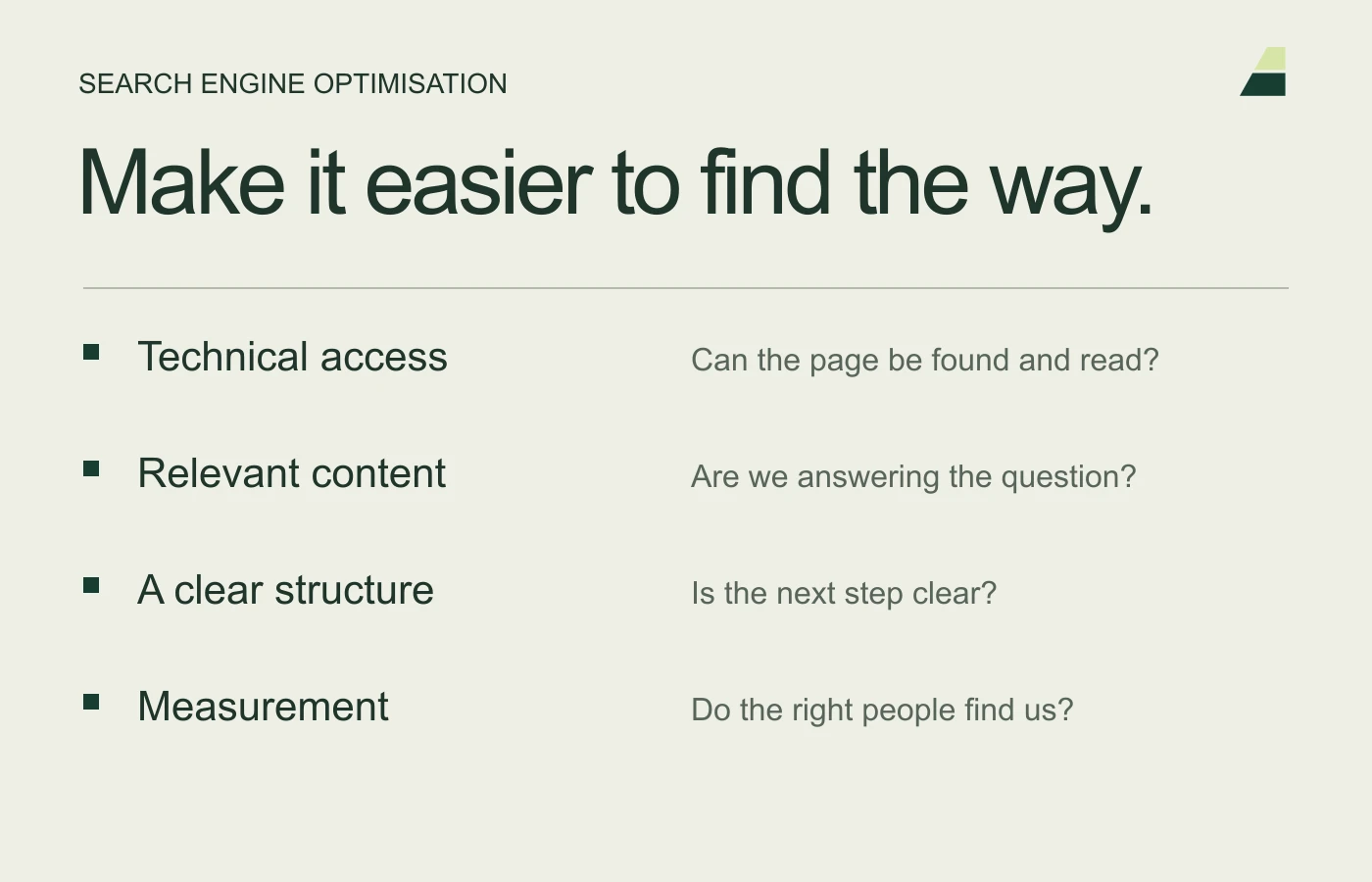
Here are four areas to prioritise. The order is practical: first, the page must be accessible. Then it must be worth visiting.
1. Make sure the right pages can be found and indexed
Check important pages in Google Search Console. URL Inspection helps determine whether Google knows the page, which URL is selected as canonical and whether anything prevents indexing. Publishing a page in WordPress does not automatically index it.
Start with service pages and other pages with a clear purpose. Check that they respond normally, are not marked with noindex by mistake, and have internal links from relevant parts of the website. A sitemap can help search engines discover URLs, but does not guarantee their appearance in search. Google’s basic guidance describes the relationship between discovery, indexing and content.
When moving a site or changing URLs, preserve useful old links. Avoid multiple versions of the same page pointing in different directions. A canonical URL indicates your preferred version; it does not replace a proper review of duplicates and internal links.
2. Create content that helps with a real task
A service page should explain what is included, whom it suits, how delivery works and what the customer needs to clarify. That is more useful than general claims of ‘quality and service’.
Use experience you can document. A project can show how a challenge was solved. A buying guide can explain differences that are hard to understand from a specification sheet. A pricing example should state its assumptions so readers can judge whether it fits their situation.
Example: A customer considering a new website needs answers about content, ownership, maintenance and measurement. An article listing design trends serves a different purpose. That is why we have a dedicated the guide to planning a new website.
There is no word count that makes an article good. Write enough to answer the question and remove repetition. Google recommends assessing originality, experience and value to the reader in the guidance on helpful, reliable content. A new year in the title is not a substantive update.
What about AI search, AEO and GEO?
Google’s guidance says the usual SEO fundamentals still apply to generative search features. Accessible content and useful first-hand knowledge matter. Google does not require special AI text files or structured markup for this. See Google’s guidance on generative search.
There is no guarantee that content will be cited in AI answers. We recommend reporting observed mentions, clicks and enquiries separately, and identifying the tool or search service measured.
3. Make the page easy to understand and use
Use a precise page title, a main heading that matches the content and subheadings that help readers navigate. Give links descriptive text. ‘See what a website project includes’ says more than a row of identical ‘read more’ links.
Write a meta description that summarises the actual offer or answer. Google may choose different text for the search result and may also change the displayed title. Titles and meta descriptions are therefore suggestions and signals, not guarantees of an exact appearance. Read Google's explanations of title links and snippets and meta descriptions.
Check mobile as thoroughly as desktop. Main content must be accessible, text and buttons readable, and forms usable. An expandable section is not an SEO problem in itself; content never accessible to Google is another matter. See the mobile guidance.
Core Web Vitals cover loading experience, responsiveness to interactions and visual stability. Good scores are useful but do not automatically bring top rankings. Google explains how these measures are used. Prioritise problems users actually encounter, such as a form that jumps as images load.
4. Measure relevant results and improve one thing at a time
Use Search Console to track queries, impressions, clicks and CTR. Look at specific pages and query groups, and consider separating brand searches from others. Overall CTR can change as a page starts appearing for new, broader searches, even if its title has not become worse.
Use website analytics and enquiries to investigate what happens after the click. An article may attract lots of traffic without bringing potential customers. A focused service page may have few visits but help exactly the people the business wants to reach.
Compare matching periods and note content, advertising and measurement changes. Monthly figures reveal breaks hidden in annual averages. Distinguish an observed improvement after an action from evidence that the action alone caused it.
A manageable start
Choose three important pages. Check indexing and mobile use, write down which customer questions remain unanswered and agree who will update the content. Then define what to monitor. This focused review gives you a better basis for decisions than changing the entire website at once.
If you need help, read about Our SEO work or use the business blogging guide as a working template for the content.
The project stories for Bondeguiden and Traktorguiden shows how we work with sources, content structure and technical accessibility in practice.