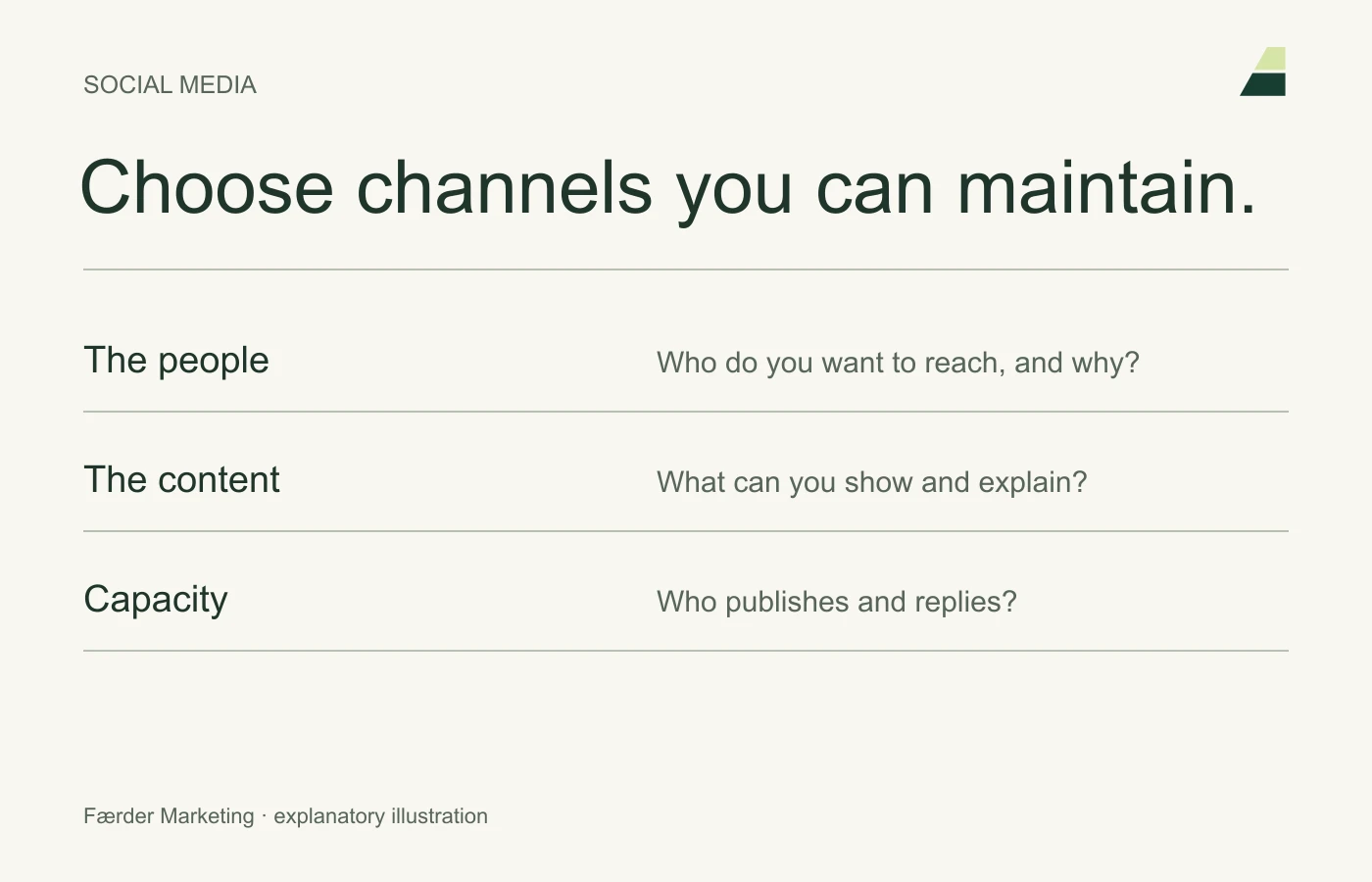
A business does not need to be active on every social network. It needs to be available where the right audience benefits from its offer, with capacity to follow up. A profile that is never maintained can create more uncertainty than value.
Start with the customers and the task. Do you want local awareness, to show products, recruit, share expertise or receive specific requests? Let the answer guide your channel choice.
Use statistics as context, not the final answer
Norwegian Media Barometer 2025, published by Statistics Norway in May 2026, provides a more recent basis than social media figures from 2017 and 2018. The survey covers people aged nine and over and shows clear differences in media use.
Be precise about what the figures mean. Daily use, monthly use, number of profiles and estimated advertising reach are different measures. Do not compare figures from different studies as though they measure the same thing. The business's actual customers may also differ from the population average.
Consider channel and content together
- Facebook: Can support local visibility, information and customer contact.
- Instagram: May suit products, processes or expert examples that can be shown visually.
- LinkedIn: May be relevant when professional role, industry and expert judgement matter.
- Snapchat and TikTok: Requires the offer, audience and content to fit how the channel is used.
- YouTube: Can help with explanations, demonstrations and content people should be able to find again.
These are possible roles, not a ranking of which channels perform best. Also consider whether search, email or website improvements should come first.
Assess capacity
Who can provide good photos and expert contributions? Who can approve content and reply? How much production time is realistic? Choosing a channel also means committing to ongoing work.
Start with one channel you can run properly rather than several you barely have time to fill. Reuse good topics, but adapt the format and next step to each surface.
Run a limited trial
Choose an objective, an audience, a few content themes and a review date. Record what you want to investigate: for example, whether expert demonstrations lead to relevant visits and conversations. Separate organic response from paid distribution.
Use clear links and an understandable contact process on the website. Test on mobile. Clarify consent and tracking before using measurement tools that record users.
Make a decision after the trial
Assess enquiry quality, content usefulness and resources used. Keep, adjust or deprioritise the channel accordingly. Low activity does not always mean the channel is wrong, but warrants investigating what is missing.
Bring the priorities together in the marketing plan. This gives social media a clear role in the business, rather than becoming an activity to keep busy with because ‘everyone else does it’.