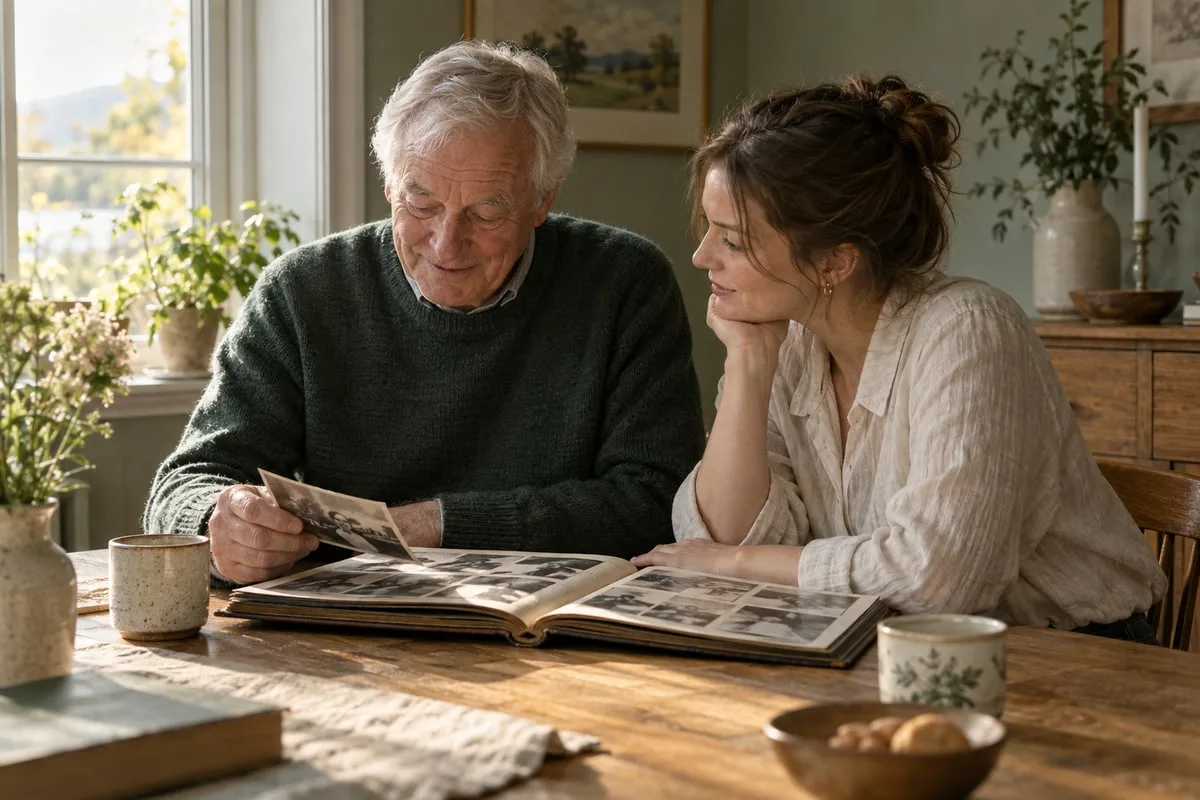
The photos are on a phone. Grandad’s story is in an album, but no one quite remembers when it was told. Only one person knows how to close the cabin for winter. Arvemappa is our own project, giving family memories and practical knowledge a place to come together.
Project transparency: Kjetil Fagereng is behind both Færder Marketing and Arvemappa. Arvemappa is operated by K28 Invest AS. This describes our own work, not an independent customer review.
A family folder that starts with people
It is easy to think a digital family folder should mainly contain paperwork. We chose to start with people. Who is in the photo? Who can tell the story? What do you know that others in the family would value?
In Arvemappa stories, photos and practical messages are collected around the family. The aim is to start with one person and one memory without first completing a whole family tree or large archive.
Practical knowledge has a natural place too. Who understands the cabin’s water system? Where is the list of important documents? Which contact should the next person know? These small explanations often become more valuable when others can find them.
A consistent experience from the first visit
Visitors do not necessarily arrive through the homepage. Their first encounter may be an article found on Google. Every entry point must therefore explain where they are, offer something useful immediately and show an understandable next step.
Arvemappa’s public pages and family version share a visual direction: calm green, readable text, clear navigation and room for content. Guides briefly introduce the service, while the questions and checklists can be used without an account.
One example is the guide with 20 questions to ask grandparents. It helps the reader start a conversation, even if the family never creates a family folder. The article should be useful in its own right.
Mobile and technical setup are part of content
We have reviewed navigation, headings, reading width and image crops across screen sizes. An article should be comfortable to read on a small phone and still hold together on a tablet or large screen.
The public pages are delivered as static HTML, with individual page titles, descriptions, URLs and a sitemap. Images are available in several sizes and modern formats, so a mobile device need not load the same image file as a large screen. The illustrative images are AI-generated and clearly labelled; they show fictional situations.
Analytics help us understand how the public pages are used. Measurement requires consent, and declining is equally easy. Private family content must not become part of marketing analytics.
The first version is complete
Arvemappa’s first version is complete, with public pages, guides and a family version. The first families can get started, and an open demo shows the service with fictional content. Further development builds on how the solution is used.
The next useful question is which small contributions families actually value collecting and where they need clearer explanations. Design, copy and features must develop from that use.
View the project story with Arvemappa images, or visit the service to explore the guides and try the demo. To see how we work with digital experiences in other contexts, read about websites from Færder Marketing.