
WordPress can still be a good choice for a business website. At Færder Marketing, however, we have changed how we build new solutions. We use more custom code, Astro and AI to shape websites and supporting systems around the way a business actually works. For clients, the aim is more useful features, a clearer customer journey and greater scope to develop the solution further.
If you are considering a new website or online shop, it helps to understand what this direction involves. A custom solution can offer valuable freedom. It also requires clear responsibility for maintenance, documentation and security. Your business needs should justify the choice.
Why we have changed direction
I have worked with many WordPress websites. That provides a useful basis for understanding what the platform does well and when a project needs something different. A content management system is useful when the main task is editing and publishing content. The requirements change when we need to connect an enquiry, a quotation, delivery and ongoing customer support.
We therefore increasingly start by asking how the process should work for the customer and the people delivering the service. From there, we can map the workflow and build the features it needs. This leaves more room for our own ideas than committing early to a template or a particular set of plugins.
It also means assessing what you already have. If a good WordPress website can be improved with a clearer offer, a better form or one carefully designed integration, that may be the right investment. A technology change earns its place by solving a problem that matters enough.
What Astro and custom code give us
Astro is a framework for building websites. By itself, it is neither a ready-made editing interface nor a complete e-commerce system. We can use it to build the pages customers see and connect the features and data sources the project needs.
Astro can generate HTML pages in advance and add interactivity where it serves a purpose. A service page may only need readable content and a contact form, while a guided tool needs logic that responds to your answers. Astro also supports pages generated on demand when content needs to be dynamic.
This is explained in Astro’s guide to interactive islands and its documentation on on-demand rendering. It can provide a good foundation for limiting unnecessary browser code. Images, fonts, tracking and implementation still affect how fast the website becomes.
When we say custom-built, we mean shaping the solution in code we can continue to develop. We still use established frameworks, libraries and services. Building payment processing, email delivery or every part of authentication from scratch is rarely a sensible use of resources.
Control also comes from the product model and the rules behind the screen: which options a customer can combine, how the price is calculated, and how staff process the order. Astro can provide the customer-facing part of that system. The framework alone does not determine how much we can customise.
How we use ChatGPT and Claude in creative work
We use ChatGPT and Claude to brainstorm, explore solutions and develop new features. It can start with a loose idea: could customers get help choosing the right service before contacting us? Or could staff avoid copying the same information between several systems?
AI makes it easier to turn these thoughts into something concrete. We can explore different ways to explain an offer, develop a prototype and work further on the code. More of the creative thinking can become something we can actually try. We can also discard an idea when testing shows that it makes the task more complicated.
Consider a hypothetical business receiving enquiries for several types of work. A short guided form could ask relevant questions, summarise the need and send the enquiry to the right person. We can use AI to explore the questions and build an initial version. Its value depends on whether customers understand the choices and the business gets better information to respond.
AI can suggest convincing-looking code that contains errors or relies on incorrect assumptions. Requirements therefore need to be clear, changes understood and important actions tested. A second AI saying that the code looks good is not an independent security review either.
A website built with AI assistance does not necessarily use AI when someone visits it. AI can be a development tool while the finished website runs on ordinary code. A chatbot or a feature that sends customer information to an AI service is a separate decision requiring its own assessment.
Where does Lovable fit?
Lovable is another tool we can consider when exploring and building a solution with AI. It can be useful for turning an idea into an interface we can try and discuss. Astro and Lovable describe different parts of the work: a framework and a development platform. A project made in Lovable is not automatically built with Astro.
Lovable documents how project code can be exported and synced with GitHub. That provides a route to working on the code outside the tool itself. Databases, file storage, authentication and other services still need to be mapped before moving. Access to source code is one part of making a solution transferable.
What we have actually changed on our own website
Færder Marketing’s website now uses Astro for the pages visitors see. Content lives in files with version history in Git. This makes it possible to inspect changes, review them and build a new version of the website.
We have also retained WordPress for purposes including historical content, older media files, administration and some email and consent functions. Our transition is a practical example of changing parts of a solution while keeping what still serves a purpose. The WordPress component still needs maintenance.

Is custom code more secure than WordPress?
The technology’s name cannot answer that question. A static page can reduce the need for publicly accessible application code to run on every visit. Forms, authentication, integrations, servers and deployment access still need protection. Custom code can also contain serious flaws.
WordPress identifies updates to core software, themes and plugins as central in its security guidance. A well-maintained WordPress installation can be a sensible choice. A custom solution needs equivalent responsibility for dependencies, access control, backups and incident handling.
As a buyer, it is more useful to ask who is responsible for security and how it is checked than whether the solution is “AI” or “WordPress”. Read what to check in a website built with AI for practical questions to ask your supplier.
What full control should mean for the client
Control needs to be demonstrable. Who owns the domain and the accounts? Who has access to the code and content? Can you export the data in a usable format? Can another developer understand, build and operate the solution if the working relationship changes?
These points need to be agreed as part of the project. Custom code does not automatically confer ownership or independence from the supplier. An undocumented solution can leave a client highly dependent on its original developer. WordPress is also open-source software and can provide substantial control. The difference often lies in the setup, agreements and what can actually be transferred.
Also agree how you want to edit content. File-based content suits our working method. A business with several frequent contributors may need an editing interface with previews and roles. That can be provided by a content system connected to the website, or it may be a reason to retain WordPress. Clients should be able to carry out routine tasks in an understandable way.
If we were building a new website or online shop today
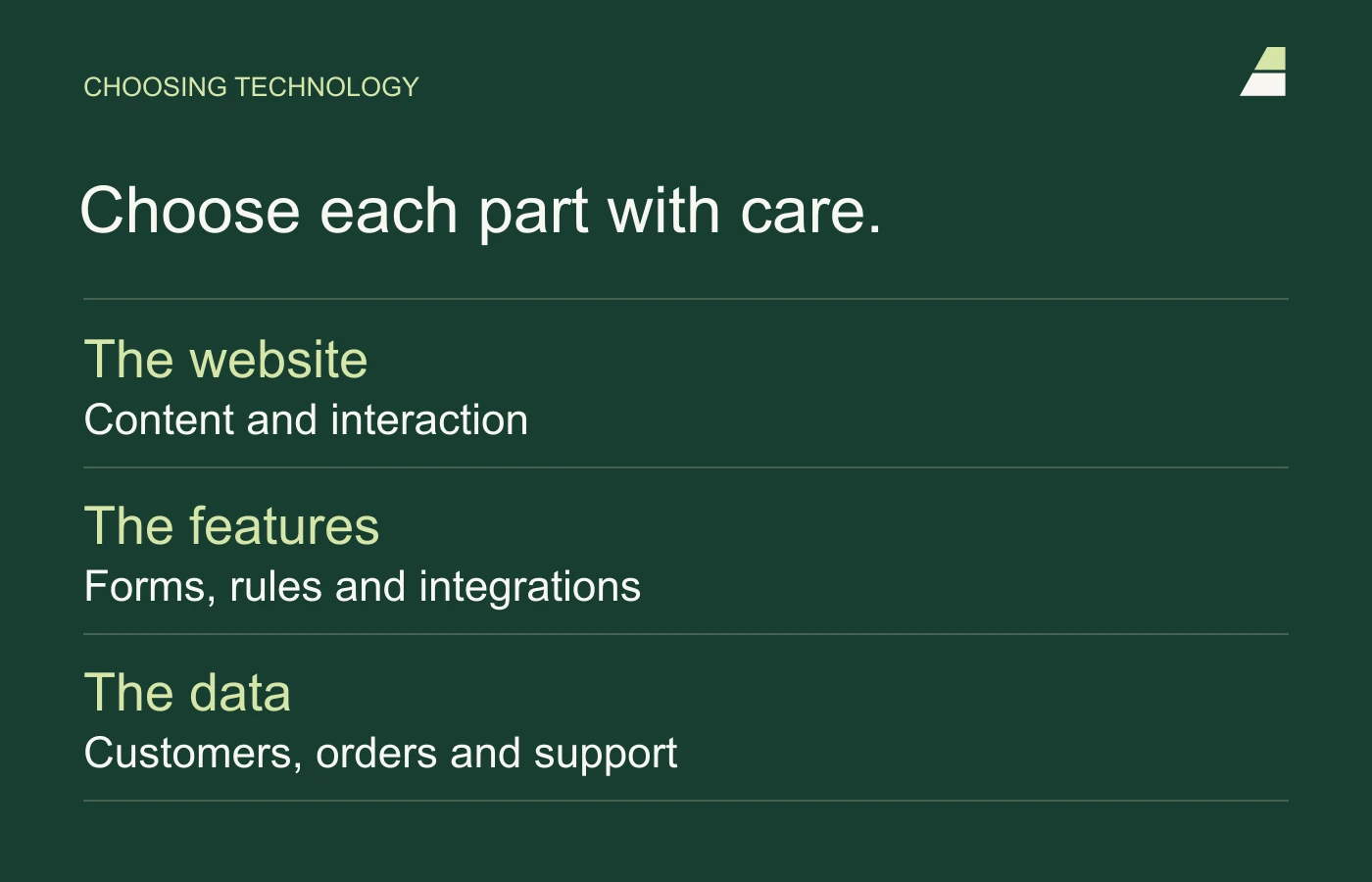
We would start with the whole process: how do people find you? What helps them choose? How does an enquiry or order arrive? Who follows up, delivers, invoices and supports the customer afterwards? We would then assess which parts to keep, buy as established services or build ourselves.
For an online shop, product information, stock, prices, payments, shipping, returns and accounting need to work together. A custom storefront is only one part of that. An established commerce system may still be the best engine, even with a bespoke customer interface. The cost of developing and maintaining integrations belongs in the assessment.
When a business needs its own product rules and workflows, we can also build the commerce logic ourselves and reuse proven components. One possible architecture combines Astro for product and content pages, React for product selection and the basket, and our own server functions with a PostgreSQL database. An established payment service can still process payments. This is an architecture we assess for each project, rather than a fixed setup we propose to everyone.
A shop can combine prebuilt information pages with dynamic product data. Prices and availability must stay up to date and be checked on the server before an order is accepted. Staff also need useful tools for products, campaigns, orders and customer service. A shop built with Astro should not require code changes every time a member of staff changes a price.
Are you considering an online shop with specific product choices or workflows? Read more about when custom e-commerce makes sense, and how we assess Astro, commerce logic and the database separately.
Compare costs over several years: initial development, licences, hosting, maintenance, further development and internal working time. AI can speed up parts of development, but it does not remove the work of defining requirements, checking quality and taking responsibility. We do not promise a lower total price simply because AI helped write the code.
What does this mean for SEO and visibility in AI search?
Choosing Astro, WordPress or an AI tool does not guarantee good rankings. Pages need to be discoverable and readable, content needs to answer relevant questions, and important URLs need to be preserved during a transition. The technology should help us carry this out well.
Google says that established SEO principles also apply to AI Overviews and AI Mode, without separate additional eligibility requirements. Indexing or appearance is not guaranteed. See Google’s guidance on AI features in Search. This provides a firmer basis than claims that AI prefers a particular framework.
Start with what you want to achieve
Before discussing a new solution, write down one task customers struggle with and one internal task that takes unnecessary time. Include the systems you use today. That gives us a concrete starting point for assessing improvements and, where appropriate, a new build.
Read how we assess a new website or online shop across the whole customer journey, or tell us what you want to achieve.