Remarketing and retargeting often refer to advertising to people who have previously interacted with a business. The terms overlap. Remarketing is also used more broadly for follow-up, such as emails to recipients you are entitled to contact.
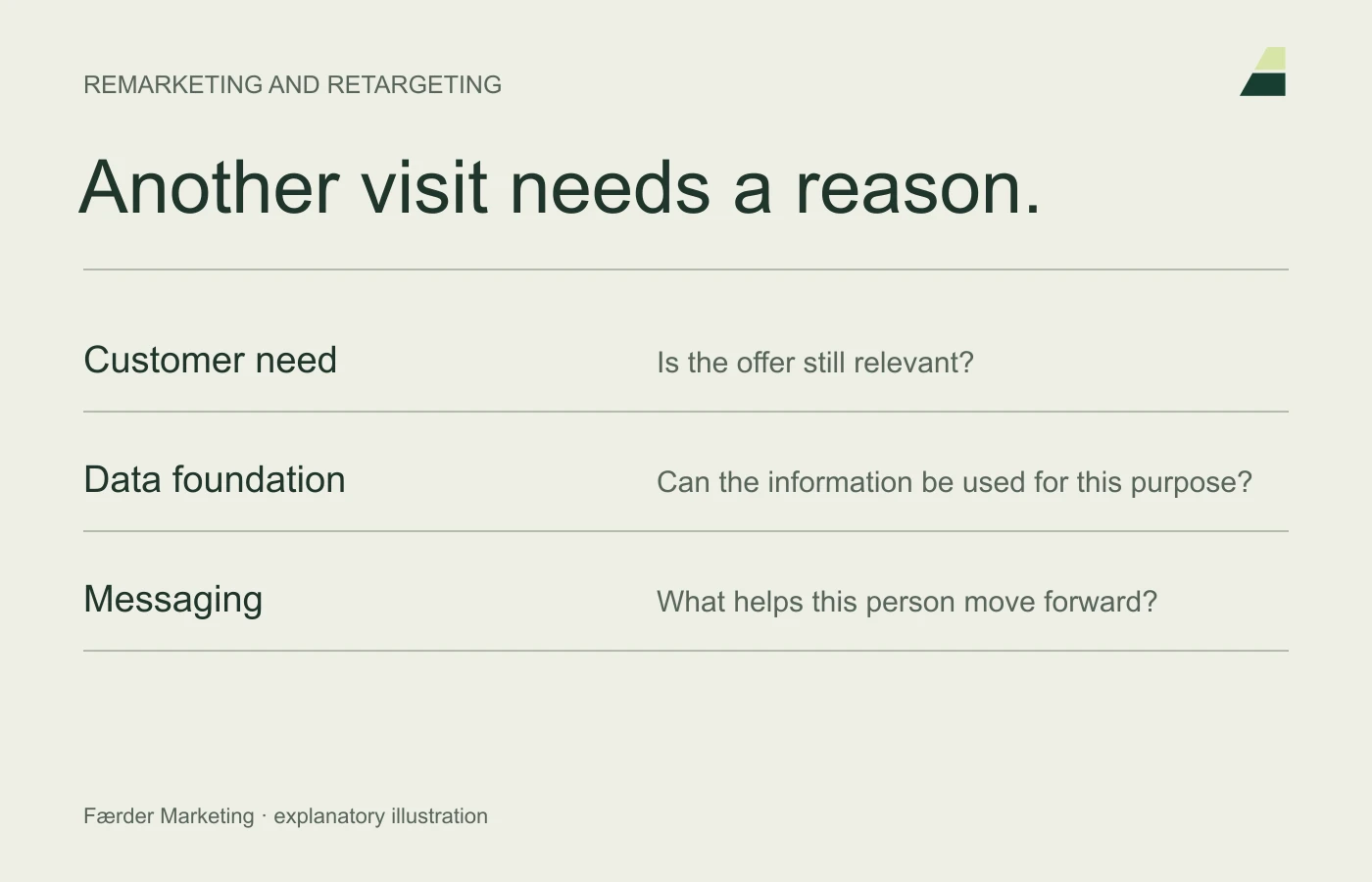
The useful questions are what the person has already done, what would help next and whether you have a basis for using the information for that purpose. A previous visit does not mean someone wants repeated ads.
Choose a specific situation
Someone who read a general article may be in a different situation from someone who evaluated a specific product. Do not automatically put every visitor in one group with the same sales message.
A hypothetical example is a customer who has researched servicing without making contact. An explanation of the process and what to include in a request may be more relevant than a generic company ad.
Understand how the audience is populated
Google refers to former remarketing lists using terms including ‘your data segments’. Google’s overview describes the use of these segments. Ad availability and delivery depend on platform requirements, the available data and the setup.
A GA4 audience is not the same as everyone who visited a page. Consent, recording and eligibility for advertising affect who can be included. Small websites may lack enough suitable data to make this worthwhile.
Clarify privacy before tracking
Advertising tracking requires you to examine consent, information and sharing with providers. The Norwegian Data Protection Authority's guidance on tracking technologies is a key starting point. A cookie solution must work technically, not merely be visible.
Avoid audiences that reveal sensitive information. Customer lists and form data need particular consideration before any upload. Read the privacy guide for a full review.
Set a duration and exclusion rules
Choose a duration that suits the buying process, rather than automatically choosing the longest possible audience membership. Consider excluding people who have already purchased or sent a relevant enquiry from the same campaign.
Watch for messages repeated too often without helping. Consider frequency, reactions, volume and cost together. Another visit does not necessarily mean the customer needs the same ad again.
Do not confuse attributed results with incremental value
An ad may receive credit for a purchase the customer would have made anyway. Retargeting often reaches people already close to a decision. High reported returns should therefore be assessed critically.
Assess total sales and qualified enquiries, using appropriate controlled tests when volume and tools allow. We do not rely on old claims that retargeting automatically multiplies purchase likelihood. Its effect must be investigated in the specific business.